

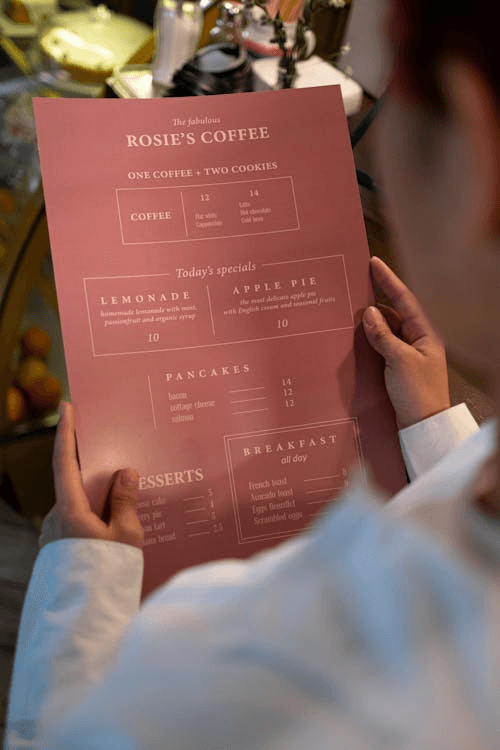
For years, menus were treated as a list.
A list of dishes, prices, maybe a few icons – and that's it.
But in the digital world, a menu is much more than that.
It is an interface.
It is a language.
And it is one of the most powerful service tools businesses have – if used correctly.
The transition from a printed menu to a digital menu shouldn't be a "copy-paste" to a new format.
That misses the real opportunity.
A Menu is a Language, Not Just Content
Every menu speaks to the user, even if not in words.
It conveys:
- How clear or confusing the place is
- If it is accessible or exhausting
- If it thinks about the customer – or just about itself
The order, the wording, the language, the hierarchy, and the context –
all influence the experience long before the choice itself.
When a menu is built correctly:
- The user understands quickly
- Feels comfortable
- And proceeds to action without hesitation
And that is exactly the point where a menu becomes a service.
Why is a Digital Menu a Critical Touchpoint?
A menu is often the first and most continuous touchpoint between a user and a system.
In contrast to:
- A sign
- Or a one-time info station
The menu accompanies the user throughout the entire experience:
Choice, understanding, decision, and sometimes further action.
When it is static –
It limits.
When it is flexible –
It opens a whole world of autonomous service.
Content Flexibility: The Key to Good User Experience
One of the biggest advantages of a digital menu is the ability to change.
Not "every other day" –
But in real-time, according to context.
A flexible menu allows:
- Different languages for different audiences
- Adaptation by time of day
- Changes based on load, availability, or location
- Displaying only relevant info, without overwhelming
So the user doesn't need to "search" –
The system already speaks to them in the right language.
Menu as a Service Engine, Not Just Selection
Once a menu stops being just a list,
It becomes a service engine.
Through it, you can:
- Order
- Get information
- Understand processes
- And continue to further actions – without a representative, without explanation, and without friction
This is true in restaurants, but not only.
In hospitals, hotels, malls, and public institutions –
The same principle works exactly the same way:
Clear content + immediate action = autonomous service.
Less Load, More Accuracy
When a menu is built properly:
- Fewer repetitive questions
- Fewer mistakes
- Less need for human intervention
The user gets answers before they ask,
And the team is free for things that truly require a human touch.
This is not replacing people –
This is wisdom in planning.
Language Creates Trust
Users feel immediately when a system "speaks to them"
And when it just presents information.
A digital menu that is adapted:
- To language
- To culture
- And to the user's knowledge level
Creates a sense of confidence.
And in places where there is pressure, load, or sensitivity –
It makes a huge difference.
From Digital Menu to Autonomous Service
The next step is clear:
When a menu is connected to a smart management system, it is no longer just an endpoint.
It becomes part of a service infrastructure:
- Measurable
- Improvable
- And constantly adaptable
So service doesn't "start when asking for help" –
It simply exists, available and clear.
In Conclusion: A Menu is a Strategic Decision
Businesses and organizations that don't understand this
Are left with a beautiful – but limited – menu.
Those who do understand:
- Plan language
- Build flexibility
- And create service that works even without intervention
A good digital menu doesn't just present options.
It leads the user, quietly, to the right action.